
This one's for Dr. Lucky...
Toni Price's first exposure to blues was through second-generation blueswoman Bonnie Raitt. After studying her recordings, Price began to study the recordings Raitt learned from, women blues singers like Sippie Wallace, Victoria Spivey and others.
She began singing in high school, but after graduating she sat in with country bands around Nashville, where she was for the most part born and raised, after moving from southern New Jersey.While living in Nashville, she listened to local blues radio programs on college stations there.
Price moved to Austin in 1989, and learned from Derek O' Brian and Cliff Antone.In her blues singing career, Toni Price cites vocalists Aretha Franklin, Emmylou Harris, Linda Ronstadt, Patsy Cline and Ray Charles as influences.
Critics have heaped praise on her gifted phrasing and delivery at her live shows and on her albums. In an interview in Austin, Price said she's never had the inspiration or desire to write songs, and figures she wasn't given that talent.
Price's albums on the Antone's/Discovery label include Swim Away (1993), Hey (1995) and Lowdown and Up (1999). Midnight Pumpkin appeared in summer 2001. Although she's relatively little-known outside of Austin's tight-knit blues community, she could be in line for a career on a par with Raitt's, if she's willing to do a lot more touring in the future. ~ by Richard Skelly for www.allmusic.com
Saturday, July 9, 1994

Thursday, July 7, 1994
Webb Wilder, Last Of The Full Grown Men ~ 1994
Born John Webb McMurray, May 19, 1954,in Hattiesburg, Mississippi, Webb Wilder is a musician who famously mixes the sounds of country, surf guitar and rock & roll known as "swampedelic". He currently resides in Nashville, TN. His first album, Webb Wilder and the Beatnecks "It Came From Nashville", was released in 1986.
The Webb Wilder character was created for a short film under the title of Corn Flicks. Wilder's Corn Flicks consists of three stories: Private Eye, Horror Hayride and Aunt Hallie and is about a backwoods private detective who fell out of the '50s and happened to also be a musician. With his group, Wilder combines the surf guitar of the Ventures with the rock roots of Duane Eddy, drawing on the feel of both country music and film noir. Though sometimes bordering on the gimmicky, the band is quite humorous yet plays serious music.
Probably the only musician with his very own "Credo":
Work Hard
Rock Hard
Eat Hard
Sleep Hard
Grow Big...and
Wear Glasses If You Need'Em!
The Webb Wilder character was created for a short film under the title of Corn Flicks. Wilder's Corn Flicks consists of three stories: Private Eye, Horror Hayride and Aunt Hallie and is about a backwoods private detective who fell out of the '50s and happened to also be a musician. With his group, Wilder combines the surf guitar of the Ventures with the rock roots of Duane Eddy, drawing on the feel of both country music and film noir. Though sometimes bordering on the gimmicky, the band is quite humorous yet plays serious music.
Probably the only musician with his very own "Credo":
Work Hard
Rock Hard
Eat Hard
Sleep Hard
Grow Big...and
Wear Glasses If You Need'Em!
Sunday, July 18, 1993
Walter Hyatt with Champ Hood ~ 1993
Born in 1950 in Spartanburg, South Carolina, Walter Hyatt was a songwriter and guitarist whose music could not be corralled into any one pen. This was always an aspect of his musical life, dating from his early listening as a child — digging into R&B and rock & roll, the latter style transforming into a maelstrom of styles all in itself in the '60s. Scholars on the subject of what makes for a good career tend to agree that Hyatt was just too eclectic to make a mark on the roots rock audience at large.
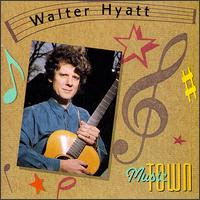
Hyatt projects had a huge influence on other musicians, and on a regional level the wonderful music of Uncle Walt's Band, with Champ Hood and David Ball, was a favorite of many a college music lover, in the days before the under-21 crowd were locked out of the honky tonks.
Although claimed as an Austin phenomenon, Uncle Walt's Band actually formed in Spartanburg, while they were still in high school. The band bounced worked between Nashville and Austin. The band appeared on Austin City Limits in 1980 (Walter appeared again as a solo artist in the 1990's) Uncle Walt called it quits to pursue solo careers in 1983.
Lyle Lovett was a fan of Uncle Walt's Band and in 1993, Lyle reach out to Hyatt and offered him opening-act slots for his tour. This was the same year Walter signed to do Alleyfest and rather than cancel, he flew in on a Sunday to appear on our stage.
Three years later Walter met an early and tragic death, however, in the crash of ValuJet flight 592 into the Florida Everglades swamp in 1996.
After Uncle Walt's Band broke up, Champ Hood had a new partnership with Austin's Jimmie Dale Gilmore and followed by some nine years working with songstress Toni Price (another Alleyfest Alumni). Lyle Lovett hired Hood for his own Large Band. The Threadgill's Troubadours was Hood's pet project in the '90s—finally, his own band after so many years as a collaborator and sideman. His son Warren Hood took up the fiddle and was himself performing on Austin City Limits in the latter part of that decade. Sadly like Walter, Champ died while still in his forties, sucumming to cancer at an early age.

Hyatt projects had a huge influence on other musicians, and on a regional level the wonderful music of Uncle Walt's Band, with Champ Hood and David Ball, was a favorite of many a college music lover, in the days before the under-21 crowd were locked out of the honky tonks.
Although claimed as an Austin phenomenon, Uncle Walt's Band actually formed in Spartanburg, while they were still in high school. The band bounced worked between Nashville and Austin. The band appeared on Austin City Limits in 1980 (Walter appeared again as a solo artist in the 1990's) Uncle Walt called it quits to pursue solo careers in 1983.
Lyle Lovett was a fan of Uncle Walt's Band and in 1993, Lyle reach out to Hyatt and offered him opening-act slots for his tour. This was the same year Walter signed to do Alleyfest and rather than cancel, he flew in on a Sunday to appear on our stage.
Three years later Walter met an early and tragic death, however, in the crash of ValuJet flight 592 into the Florida Everglades swamp in 1996.
After Uncle Walt's Band broke up, Champ Hood had a new partnership with Austin's Jimmie Dale Gilmore and followed by some nine years working with songstress Toni Price (another Alleyfest Alumni). Lyle Lovett hired Hood for his own Large Band. The Threadgill's Troubadours was Hood's pet project in the '90s—finally, his own band after so many years as a collaborator and sideman. His son Warren Hood took up the fiddle and was himself performing on Austin City Limits in the latter part of that decade. Sadly like Walter, Champ died while still in his forties, sucumming to cancer at an early age.
Monday, July 12, 1993
Brave Combo, Nuclear Polka Band ~ 1993
Brave Combo are a polka/rock band based in Denton, Texas. Founded in 1979 by guitarist/keyboardist/accordionist Carl Finch, they have been a prominent fixture in the Texas music scene for more than twenty-five years. Their music, both originals and covers, incorporates a number of dance styles, mostly polka, but also rumba, cha-cha-cha, choro, samba, two-step, cumbia, charanga, merengue, etc.
As part of their perceived artistic mission to expand the musical tastes of their listeners, they have often played and recorded covers of well-known songs in a style radically different from the original versions. Examples include polka versions of Jimi Hendrix's "Purple Haze" and The Doors' "People are Strange", The Rolling Stones' "(I Can't Get No) Satisfaction" as a cha-cha, and "Sixteen Tons" as a cumbia. While their records may have a sense of humor, they are played straight and not usually considered joke or novelty records.
As part of their perceived artistic mission to expand the musical tastes of their listeners, they have often played and recorded covers of well-known songs in a style radically different from the original versions. Examples include polka versions of Jimi Hendrix's "Purple Haze" and The Doors' "People are Strange", The Rolling Stones' "(I Can't Get No) Satisfaction" as a cha-cha, and "Sixteen Tons" as a cumbia. While their records may have a sense of humor, they are played straight and not usually considered joke or novelty records.
Friday, June 25, 1993
Joe "King" Carrasco ~ 1993 & 2002
One of the real "characters" to play at Alleyfest, Joe Carrasco was born in Dumas, Texas. His name Joe Teusch doesn't quite has the proper Tex-Mex ring so enter Joe "King" Carrasco. He founded the band "Joe 'King' Carrasco and El Molino" in Texas in the late 70s. The band appeared at the now-infamous Raul's club,a live music nightclub in Austin near the UT campus which specialized in punk rock music.
By 1979 he had formed the Crowns and was calling his music "nuevo wavo," playing especially in New York, where he appeared on stage in a cape and crown. He was signed to the U.K. Stiff label and Joe Boyd's Hannibal label in the U.S., and released Joe "King" Carrasco and the Crowns in 1980. By 1982 he had moved up to major label MCA for Synapse Gap, followed by Party Weekend (1983). ~ Wikipedia / Allmusic Guide
A true self promoter, get the full scoop on Joe's current goings on at his website: www.joekingcarrasco.com
Here's Joe on Joe:
Bonus: Here's Joe and El Moleno!
By 1979 he had formed the Crowns and was calling his music "nuevo wavo," playing especially in New York, where he appeared on stage in a cape and crown. He was signed to the U.K. Stiff label and Joe Boyd's Hannibal label in the U.S., and released Joe "King" Carrasco and the Crowns in 1980. By 1982 he had moved up to major label MCA for Synapse Gap, followed by Party Weekend (1983). ~ Wikipedia / Allmusic Guide
A true self promoter, get the full scoop on Joe's current goings on at his website: www.joekingcarrasco.com
Here's Joe on Joe:
Bonus: Here's Joe and El Moleno!
Saturday, June 20, 1992
From the beginning...The Stratoblasters ~ 1992
In 1986, when opening for Delbert McClinton at Redux in Dallas, the back-stage banter again turned to this artistic fantasy. At the very moment that it dawned on guitarist Jimmy Wallace and bassist Bobby Chitwood that they would indeed require a lead vocalist if this ethereal concept was ever to actually take shape an old friend (and vocalist extraordinaire) named John O'Daniel bounded back-stage and approached the two. After the usual greeting rituals, Jimmy and Bobby looked at each other, nodded, and the nucleus of the Stratoblasters was solid.
Jimmy's old friends and guitarists Jerry Don Branch and Matt Tapp were offered the opportunity to join the party, and without hesitation signed on. The idea was a three guitar band that anteed up the energy necessary to blast out vintage R&B, soul and any other genre of interest - to the point of extreme personal satisfaction of the band members. This, as it worked out, was very easy to achieve. The question was, would anyone else care?
On September 6th , 1986 the Stratoblasters played to a small audience of friends and family. For the band members it was simply electrifying. The audience was small but contagiously receptive. Through that September and October the band played at Redux sharing with Bugs Henderson his bass player Bobby Chitwood and drummer, Mike Gage.
The group had an absolute blast (no pun intended) being allowed to perform on stage in the very manner that they had dreamed of for so long. Working for the door on a weeknight, they consistently made enough nightly proceeds to cover the cost of Mexican food for all, at the close-by Guadalajara restaurant after the gig.
Then a puzzling thing happened. The fun and excitement that each and every band member felt, each and every song - leapt off the stage and permeated the audience thus beginning a reciprocal relationship that honestly exists to this very day.
Jimmy's old friends and guitarists Jerry Don Branch and Matt Tapp were offered the opportunity to join the party, and without hesitation signed on. The idea was a three guitar band that anteed up the energy necessary to blast out vintage R&B, soul and any other genre of interest - to the point of extreme personal satisfaction of the band members. This, as it worked out, was very easy to achieve. The question was, would anyone else care?
On September 6th , 1986 the Stratoblasters played to a small audience of friends and family. For the band members it was simply electrifying. The audience was small but contagiously receptive. Through that September and October the band played at Redux sharing with Bugs Henderson his bass player Bobby Chitwood and drummer, Mike Gage.
The group had an absolute blast (no pun intended) being allowed to perform on stage in the very manner that they had dreamed of for so long. Working for the door on a weeknight, they consistently made enough nightly proceeds to cover the cost of Mexican food for all, at the close-by Guadalajara restaurant after the gig.
Then a puzzling thing happened. The fun and excitement that each and every band member felt, each and every song - leapt off the stage and permeated the audience thus beginning a reciprocal relationship that honestly exists to this very day.
Friday, July 19, 1991
Dallas Brass and Electric ~ 1991 & 1992

Dallas Brass & Electric consists of a four piece rhythm section (drums, bass, guitar, keyboards), a three piece horn section (trumpet, sax, trombone) and is fronted by both male and female singers. The male vocalist is none other than Derrick "D-Mac" McCampbell. In 1990 D-Mac sang lead on the MAC Band's Roses Are Red which reached #1 on the both the US and UK charts.
Dallas Brass & Electric's repertoire covers a wide range of styles including Top 40, Rock, Swing and Commercial Jazz with particular emphasis on R&B and 70's dance favorites.Dallas Brass & Electric's stylistic range extends even to jazz standards and big band titles making the band the complete musical solution for those functions beginning with dinner music or a cocktail reception and ending with high energy dancing.
Subscribe to:
Posts (Atom)
